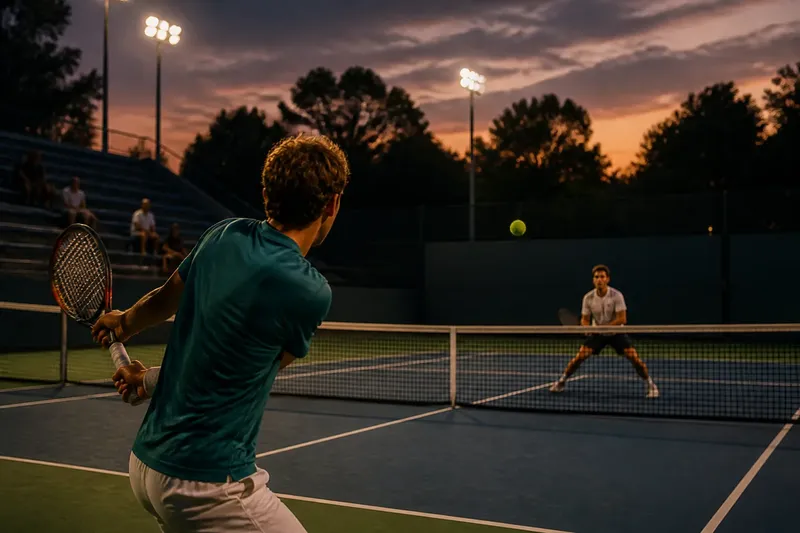
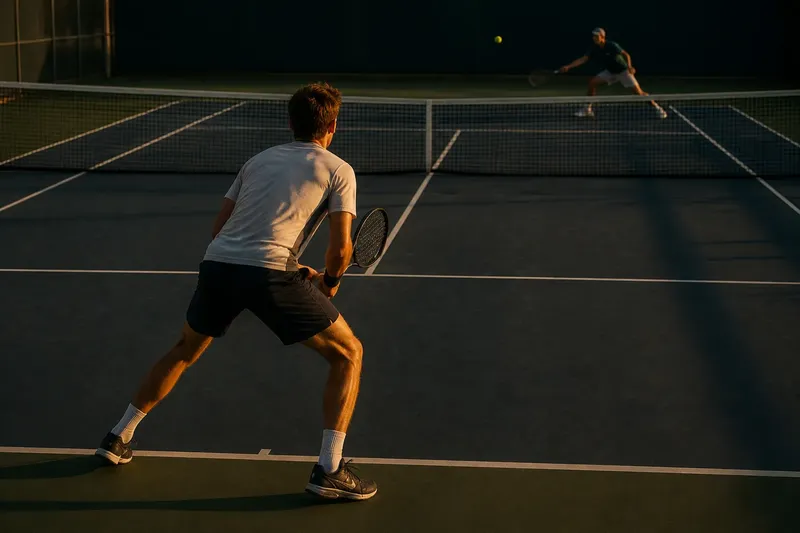
The Open Court: Why a Wide Angle Changes the Next Shot
Learn how a wide tennis angle changes open space and recovery time, so you can choose a reply that fits your opponent’s position rather than a fixed rule.
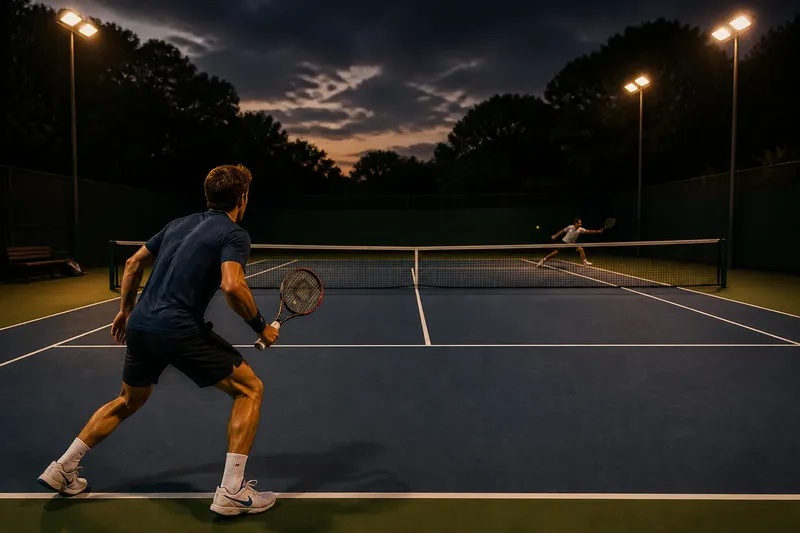
The common mistake after pulling an opponent wide is to assume the court is now open on the opposite side. In tennis, the open court depends on where that player can reach and recover from, so choosing the wrong reply can send the ball straight into their path. Read the opponent’s position first; then use the geometry of the court to decide where your next shot should go.
What does a wide angle change?
A crosscourt shot travels diagonally across the net and draws the receiver toward a sideline. The wider the ball pulls them, the more lateral ground they must cover to reach it, but that movement also changes the space behind and beside them.
Imagine your opponent starts near the middle of the baseline and you send a firm crosscourt forehand toward their backhand corner. They move outward to play it. If they contact the ball while still traveling, their next recovery step may carry them farther toward the sideline than if they had reached it early and balanced.
That difference matters because the court is not a static diagram. The ball’s location, the opponent’s contact point, and their momentum together shape the next opening. A shot toward one side can leave a usable lane elsewhere, but it does not automatically make the far corner the best target.
Where is the opponent when they make contact?
Start by locating the receiver at the instant they hit your wide ball. Notice their distance from the singles sideline, whether their feet are set, and whether their body is moving outward, back toward the court, or already recovering.
A player contacting the ball near the sideline may have several possible replies. They can send it crosscourt, where the net is lower and the path is longer, or redirect it down the line, where the route is shorter but the net is higher. Their balance and contact point influence which option is comfortable, while your own position affects which reply is most dangerous.
Do not judge their position only by the ball’s bounce. A player who reaches the ball early may meet it inside the court and have room to redirect. A player arriving late may be stretched near the line and more likely to send a defensive ball toward a safer, higher-margin area.
How do you map the available space?
Think of the court as lanes rather than as a single empty corner. From your opponent’s contact point, the available reply may travel crosscourt, down the line, or through a more central path. Your position determines which lane you can cover without abandoning another.
If you are near the center of the baseline, you may be able to move toward either sideline. If you have already shifted toward the side where you struck the wide ball, the down-the-line reply may require a longer chase. The open space is therefore partly created by your own position, not just by the opponent’s movement.
Use the net and sidelines as practical boundaries. A crosscourt reply has more court length to work with but can angle away from you; a down-the-line reply has less distance to travel but must clear a higher portion of the net and stay inside a narrower lane. These are tradeoffs, not automatic predictions.
What should you do before the next shot?
After hitting wide, recover toward a position that gives you access to the likely replies. This does not always mean running to the exact center mark. If your opponent is stretched and contacting the ball near a sideline, shift toward the lane that would take longest for you to cover while keeping enough balance to change direction.
Keep your feet active as the opponent swings. A small split step timed around their contact helps you respond in either direction; leaning early toward the apparent open court can leave you stranded if they choose the other lane. Your goal is to be ready for the ball they can actually hit, not the space that looks empty on the court.
Say you hit a crosscourt ball from the deuce side and your opponent reaches it near the opposite singles sideline. You recover slightly toward the likely down-the-line lane because you are already positioned to cover the crosscourt angle, then split step as they strike. If they send the ball back crosscourt, you still have a chance to move; if they redirect down the line, your starting position has reduced the distance you must cover.
How can you tell whether to attack or defend?
Read the quality of the opponent’s contact before choosing an aggressive position. A balanced player with time can redirect the ball more confidently, while a player stretched off balance is more likely to lift a defensive reply or send it toward a less demanding target. Treat those as tendencies, not rules.
If the opponent is late and reaching, move forward only when your own shot allows it and you can still cover a passing reply. If they meet the ball early and balanced, hold a more neutral position and prepare for a sharper angle. Your next movement should follow the opponent’s contact and racket path, not a fixed instruction to charge toward the far corner.
Also account for your own shot. A short, slow ball gives the opponent more time to set their feet and use the angle; a deeper, more forceful ball may limit their choices. A wide angle is most useful when it makes the receiver move under pressure while leaving you enough time to prepare for the response.
Which reply should you expect from a wide ball?
Can a stretched player still hit down the line?
Yes. A player near the sideline can redirect down the line, especially if they arrive early and keep their balance. Leave room for that reply rather than assuming the ball must come back crosscourt.
Is crosscourt always the safest response?
No. Crosscourt offers a longer court and a lower part of the net, but it may send the ball toward a player who has already recovered that way. Choose the direction that fits the receiver’s position and your own court coverage.
When should you move toward the open court?
Begin adjusting as the opponent prepares to strike, but avoid committing before you read the contact. A split step keeps your first movement available in either direction.
Does a wider angle always create a better opening?
Not necessarily. A wide shot can pull the opponent off court, but a short or weak ball may give them time to reach it and redirect sharply. Judge the quality of the shot alongside its angle.
How can you practice reading the geometry?
In a cooperative baseline rally, agree that one player will occasionally hit crosscourt toward a singles sideline while the other aims to return to either side. The player who hit wide should call out the opponent’s contact position—early, balanced, stretched, or moving outward—then adjust their recovery before the reply. Keep the call brief so attention stays on the ball.
After each point, ask which lane was genuinely available and whether the receiver’s balance changed your expectation. If your starting position made one reply difficult to reach, notice that too. This turns court geometry into a live decision rather than a diagram to memorize.
The most useful open-court judgment is not “hit to the opposite corner.” It is “where can this player send the ball from here, and which reply can I cover from my position?” Use that question after every wide angle, and the next shot becomes easier to read without becoming predictable.