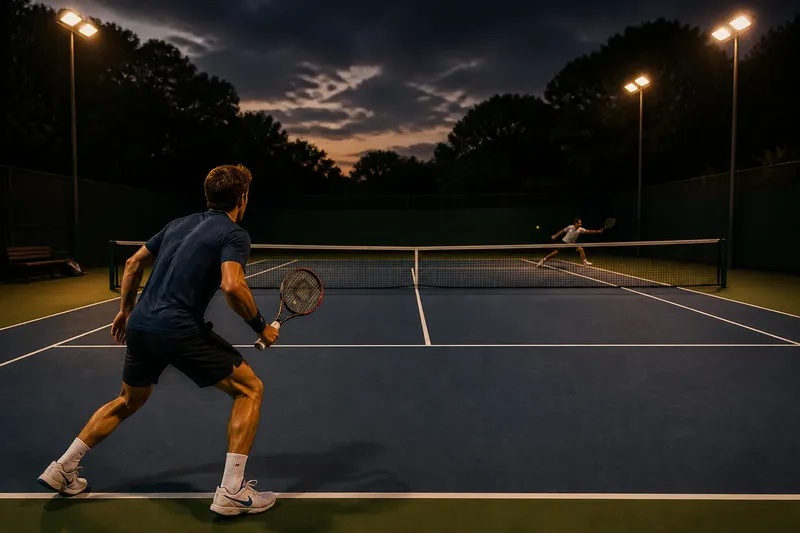
Watching Doubles from the Service Box
Watching doubles from the service box gets easier when you track the server’s partner and the gap between partners instead of chasing every ball.
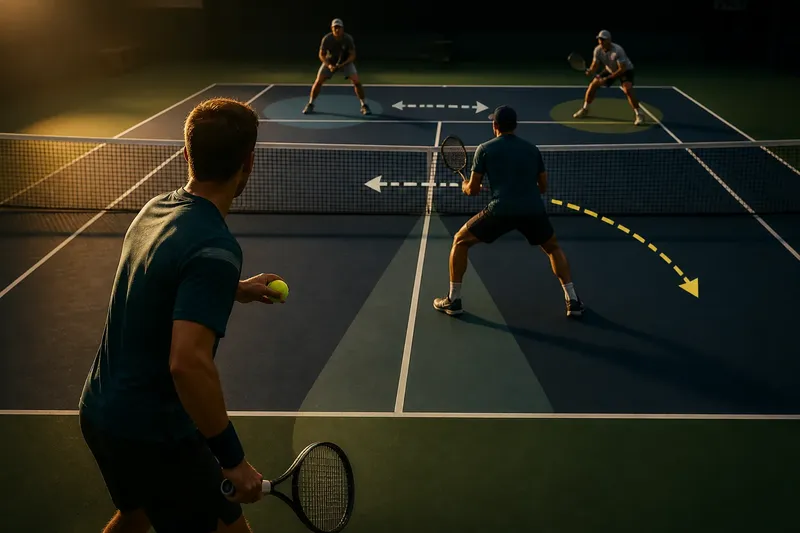
The common mistake when watching doubles from the service box is to follow the ball from racket to racket. That leaves you looking away just as the server’s partner moves, and the point can seem like a blur. Watching doubles from the service box is easier if you pick one player without the ball and read how the space between partners changes.
The server’s partner is often the clearest starting point: their position hints at which reply the serving team expects and what space it wants to close. You do not need to predict the shot correctly. Notice the movement, then see whether the returner’s choice fits the opening that appeared.
Why follow the server’s partner first?
The partner at the net has to make decisions before the ball reaches them. They may hold their ground, shift toward the center, or move across to intercept a return. Each choice changes the picture for the returner, even if the partner never touches the ball.
At the start of a point, note the partner’s position relative to the service line and the center service line. Then glance at the returner and the server. This gives you a simple map: who is close enough to threaten a volley, who is covering behind, and where a return might pass.
Keep your attention on the partner while the serve travels. After the return, look at the gap between the two serving players. If the partner has moved across, the server may be sliding behind them to cover the open side. If the partner stays still, the server may need to protect more court alone.
Should you track the gap or the partner’s movement?
There are two useful viewing approaches, and each suits a different kind of first match. Watching the partner is more direct: it makes a single player’s intention easier to notice. Watching the gap is more relational: it shows how the pair divides responsibility after each shot.
Choose partner-first viewing if you are still learning doubles positions or find the ball difficult to follow. Choose gap-first viewing if you can keep a broad view of both players and want to understand why a team leaves one area open. Neither approach requires you to track every stroke.
- Partner-first: Watch whether the server’s partner holds, shades toward the middle, or crosses. Ask what return that movement might discourage.
- Gap-first: Watch whether the distance between the partners widens, narrows, or shifts to one side. Ask which player is now responsible for the exposed lane.
- Ball-first: Follow the exchange only long enough to identify the direction of the return, then return your gaze to the pair’s shape before the next shot.
The ball-first approach is useful for a short exchange, but it can be tiring if you use it for every point. Think of it as a check, not the whole viewing plan.
What does the space between partners reveal?
The gap is not simply empty court. It is a clue to how the pair expects to handle the next shot. A narrow gap may show that both players are protecting the middle; a wider one may reflect coverage of the sidelines or a partner preparing to cross. The meaning depends on the ball and the players’ starting positions, so read the gap as a changing choice, not a fixed formation.
Notice what happens just after the return. If the net player moves toward the middle and the server shifts behind, the pair may be trading coverage: one threatens an interception while the other guards the space left behind. If both drift toward the same side, the opposite lane becomes more visible to you—and potentially to the opposing team.
Say you are watching a right-handed server from behind the baseline, with the partner near the net. The returner sends the ball toward the server’s side, and the partner takes a small step toward the center. Watch whether the server moves behind that step to cover the other lane; if so, you can see the partners sharing the court rather than merely chasing the ball.
How can you read a point without following every shot?
Use a three-part viewing rhythm: set the picture before the serve, watch the partner during the serve, and check the gap after the return. This keeps your gaze on the decision that shapes the point while still letting you register where the ball goes.
- Before the serve, locate both serving players and note which side of the court the returner occupies.
- During the serve, watch the net player’s first movement rather than trying to judge the serve’s speed or placement.
- After the return, glance at the gap between partners and see who appears ready to cover the next lane.
- At the point’s end, ask whether the team’s movement matched the return direction or left a lane exposed.
This rhythm is a viewing aid, not a rule about how players must position themselves. A team may hold its shape, change sides, or use a formation that looks unusual; the useful question is what the movement asks the opponents to do.
Which doubles positions should a new viewer recognize?
What is the server’s partner trying to do?
The partner usually tries to make the return less comfortable by occupying space near the net or showing a possible interception. Watch their first move after the serve, then compare it with the returner’s direction.
Why does the server move after the return?
The server often has to cover the court behind the partner, especially if that partner moves toward the middle. A sideways recovery can be more informative than a return to the starting spot because it shows which lane the server expects to defend.
What is poaching in doubles?
Poaching is when the net player crosses toward the other side to intercept a shot intended for their partner. For a viewer, the important detail is the space left behind the crossing player and whether the server shifts to cover it.
What if both partners stay back?
If the serving pair begins with both players near the baseline, watch how they divide the court after the return rather than expecting a net interception. Their spacing still matters: a coordinated shift can close one lane while leaving another as the opponent’s safer option.
How should you choose an approach for a full match?
Start with partner-first viewing for a few points if the formations are unfamiliar. Once you can spot the partner’s hold, shift, or cross, add the gap as a second cue; this helps you see how one player’s move changes the other’s responsibility.
If the rally becomes fast, let the ball go briefly and return your attention to the players’ shape at the next pause or point. You are not missing the whole story: the pair’s spacing often explains the next decision better than a hurried attempt to identify every contact.
For watching doubles from the service box, the most useful habit is to alternate between one player’s movement and the space their movement creates. Choose the partner-first approach when you want a clear individual cue, and the gap-first approach when you want to read the pair as a unit. That small change gives each point a visible pattern, even when the ball moves too quickly to follow.